Integrated PIM & DAM as content turbo for website and e-commerce solution
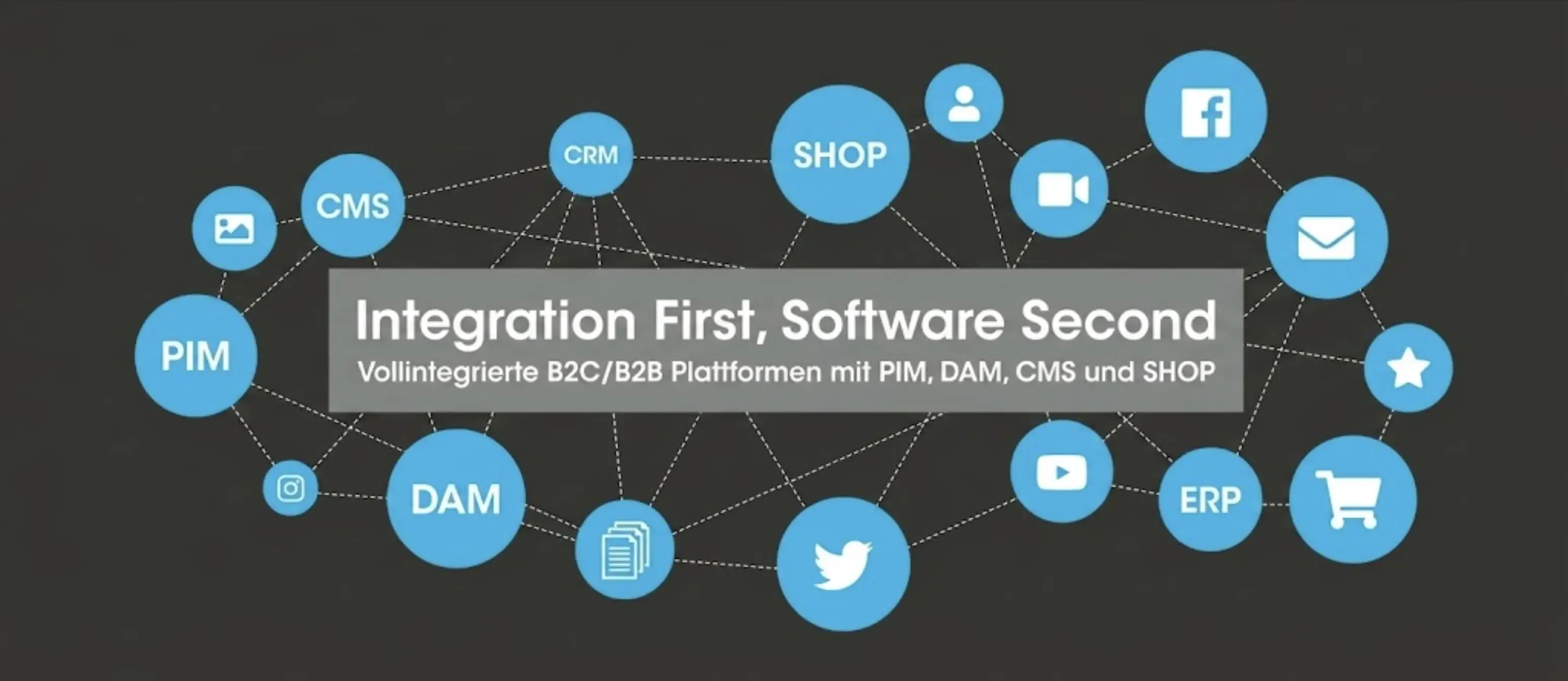
Content is king! All e-commerce consultants agree on this point. Top rankings on search engines and platforms, conveying brand values, user experience that makes a difference – none of this is possible without content. In addition to ERP and CRM, PIM and MAM systems have become the most important backend components for e-commerce solutions. However, the mutual integration of these systems is crucial for successful content and commerce scenarios.
Although the integration of e-commerce sites with enterprise systems such as ERP and CRM plays an important role, these systems are less significant for e-commerce than PIM and MAM systems. Prices, availability, market allocations, fulfilment status and similar information come from the ERP, and orders are also sent there. Customer data comes from the CRM, and new prospects are added there from the online presence. But these are just the basics, without which nothing works, but which also make no difference.
What gives you the edge over the competition, the advantages of your products and services, the uniqueness of your brand, the customer focus of your website itself, its ease of discovery – all this is achieved through images, graphics, videos, animations, texts, technical data, overviews, comparisons, structures, relationships, keywords, etc. In a modern e-commerce solution, these are created and maintained in the MAM and PIM systems and made available for the output channels. That is why the professional use of these systems is so important, combined with their seamless and high-performance integration into the system landscape. The latter is a prerequisite for efficient and cost-effective content maintenance on the one hand, and for its constant availability for all markets, languages and target groups on the other.
PIM-Integration
The use of a PIM system enables a company to transfer any content to its website, online catalogue or online shop in a finely granular, structured and pre-packaged form. Print editions, especially web-to-print, such as the fully automated creation of constantly updated data sheets, package inserts, assembly instructions, price lists, warning notices, etc., including their provision for online download, are just as much a part of the advantages as the automated creation of complete or partial catalogues.
On the processing side, the PIM system enables efficient and quality-assured product data maintenance across any number of languages and markets, including different measurement systems such as metric and imperial, plus professional translation management. This significantly improves content creation and makes it more cost-effective.
Successful PIM integration can be beneficial in both the short and long term. Integration increases productivity by reducing manual input, presenting products in a comprehensive manner with up-to-date descriptions, technical data and images, and adding significant value through additional functions such as product comparison, product finder, product configurators, links to related products, variants or dynamic search.
MAM-Integration
MAM systems enable the simple and efficient creation, editing and provision of media content such as images, graphics, videos and animations in a wide variety of formats. However, a MAM component is usually already available as part of the PIM system for product data. Nevertheless, a separate MAM system can be useful, especially if there is a lot of media content in addition to product media and this content is also to be made available separately – for example, to marketing, sales, partners, social media, content portals or the press.
If a separate MAM system is used, it must be integrated multiple times. On the one hand, it must be integrated into the PIM system, because in this case it makes sense to manage the product media in the MAM rather than in the PIM. On the other hand, it must be integrated into the CMS system so that the media can be used in editorial articles. The same applies to all other systems that use the media, such as email marketing tools or social media management tools.
PIM/MAM to ERP and CRM integration
PIM integration cannot be carried out without considering the integration of ERP and, if necessary, CRM. In a powerful and high-performance content and commerce ecosystem, ERP is typically networked in many ways. This means that the master data for new or modified products is automatically transferred to the PIM, eliminating the need for multiple maintenance and ensuring that data is always up to date. Conversely, status changes are transferred from the PIM to the ERP, e.g. "online live in market EMEA since DATE", so that processors do not have to consult multiple systems. Standard prices are also transferred from the ERP via the PIM to the publication channels, e.g. for the corporate website, online catalogues, landing pages or print objects.
On the other hand, availability, customer-specific prices and discounts or prices of configurable products are transferred directly and dynamically from the ERP to the online catalogue and the e-commerce system, and from these enquiries or orders to the ERP. The e-commerce system and ERP also dynamically exchange information about the status of processes such as order processing, and the order history requests archived documents such as invoices, orders, delivery notes and credit notes.
CRM integration makes sense if the e-commerce system is to offer special promotions based on customer status in the CRM. It can also be useful in terms of marketing automation to transfer certain customer activities to the CRM in order to generate even more personalised offers across all channels. PIM, MAM, ERP and CRM data can also work together in a coordinated manner if, for example, certain products (PIM) with certain images (MAM) and a certain discount (ERP) are only to be displayed to a selected group of customers (CRM).
PXP solutions from INFOLOX– mixing is possible
The INFOLOX PXP solutions combine all these integration scenarios with front-end integration of content and commerce through an integrated CMS and e-commerce system. This enables companies to coordinate all scenarios in line with their desired customer experience and customer journey – with consultants, designers and technicians who have a complete overview of the company's goals and requirements.
The Omnichannel Box is not only a powerful integration solution for all front-end and back-end integrations, it also includes a comprehensive consulting methodology: from strategy and implementation to continuous optimisation. Contact us if you would like to learn more!