What is a B2B customer portal, dealer portal or self-service portal?
To help you understand exactly which platform best suits your business model, what specific benefits it offers, and how the underlying technology works, we have summarised the key questions and answers for you:
FAQ: Key principles of digital customer relationships in B2B
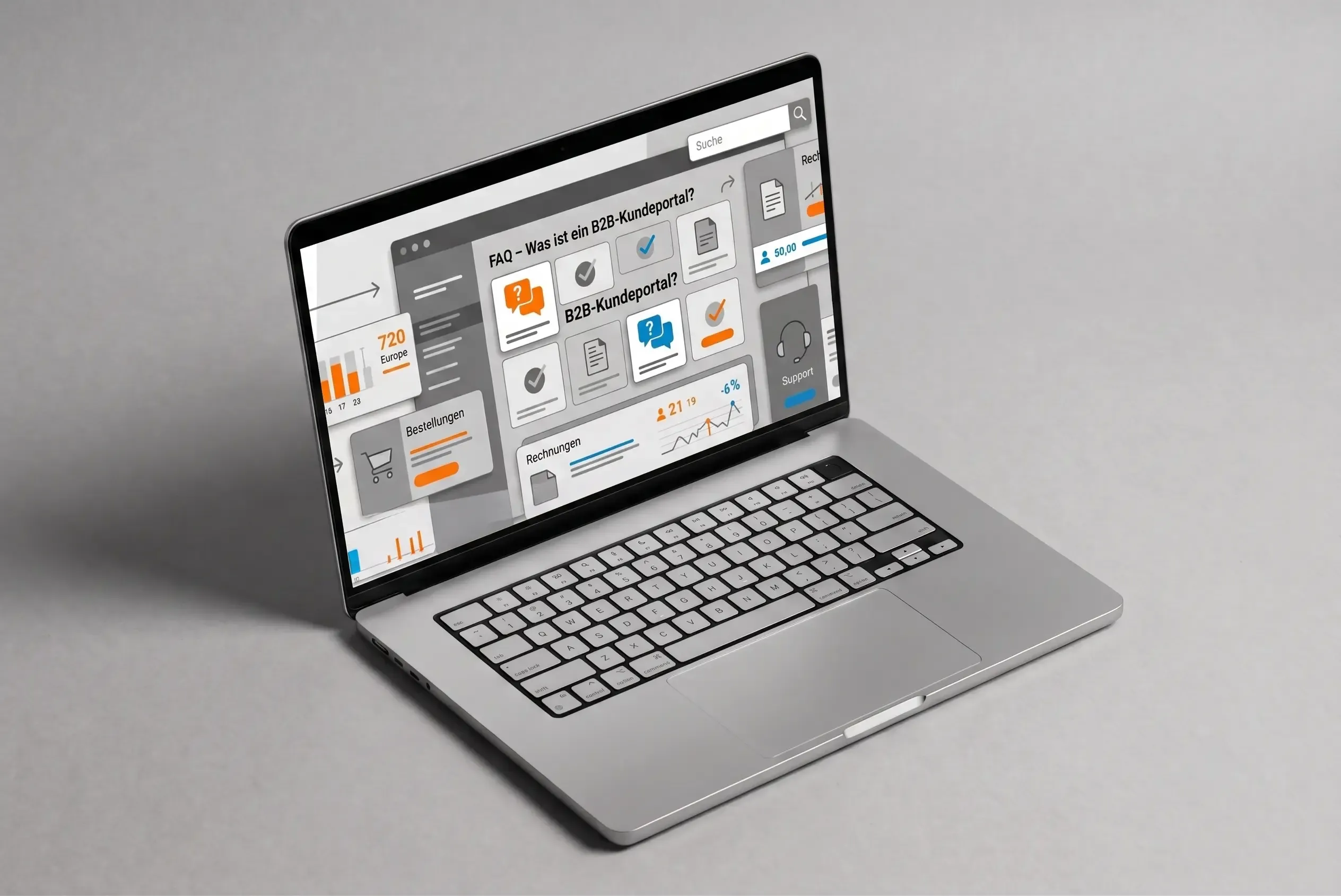
What is a B2B customer portal? A B2B customer portal is a central digital interface that goes far beyond a traditional online shop. It acts as a ‘digital employee’ available 24/7, enabling business customers not only to carry out transactions (such as orders and quotations), but also providing comprehensive information (product data, certificates), financial documents (invoices, credit notes) and service and support functions. B2B customer portals are the key to long-term and efficient customer relationships.
What is a dealer portal? A dealer portal is a specific type of B2B customer portal that is precisely tailored to the needs of distributors, wholesalers and specialist retailers. The focus here is on maximum efficiency and speed in the procurement process: customer-specific prices, framework agreements, quick orders via parts list upload, visibility of availability (ATP/CTP) and deep e-procurement integrations (such as punchout or EDI) are at the heart of a successful dealer portal.
What is a B2B self-service portal? A self-service portal in the B2B sector is a digital platform that enables business customers to carry out routine administrative tasks and retrieve information entirely independently. Instead of calling the office or support team, customers can use the self-service portal to check their order status, download delivery notes, process returns (RMA), create service tickets or access technical data sheets and CAD models. This reduces costs for the supplier and increases customer satisfaction.
How does a B2B customer portal work in practice? A modern B2B customer portal operates through strict role and access rights management combined with personalised content. When a user logs in, the system recognises their organisation, department and budget limits. A buyer, for example, sees individual price lists, approval workflows and order histories. A technician from the same client company, on the other hand, sees maintenance plans, CAD drawings and the management of the installed base (My Assets). The portal adapts dynamically to the specific use case.
How do dealer portals and self-service portals work from a technical perspective? To ensure that dealer portals and self-service portalsdeliver the desired added value (and ROI) in practice, they do not operate as isolated stand-alone solutions, but through deep integration into the existing system landscape. A composable architecture connects the portal front-end with back-end systems: the ERP system provides real-time data on prices, stock levels and order status. The PIM (Product Information Management) system ensures error-free product data and documents, whilst the CRM system synchronises contracts and service tickets.