2025 was a landmark year for digital product development. First, Figma went public – a clear signal of the importance of design tools in the modern software landscape. Shortly afterwards, the next bombshell followed: Figma acquired Payload, which we consider to be the most innovative and technologically advanced WebAppBuilder with integrated headless and API-first CMS.
Why is this so important?
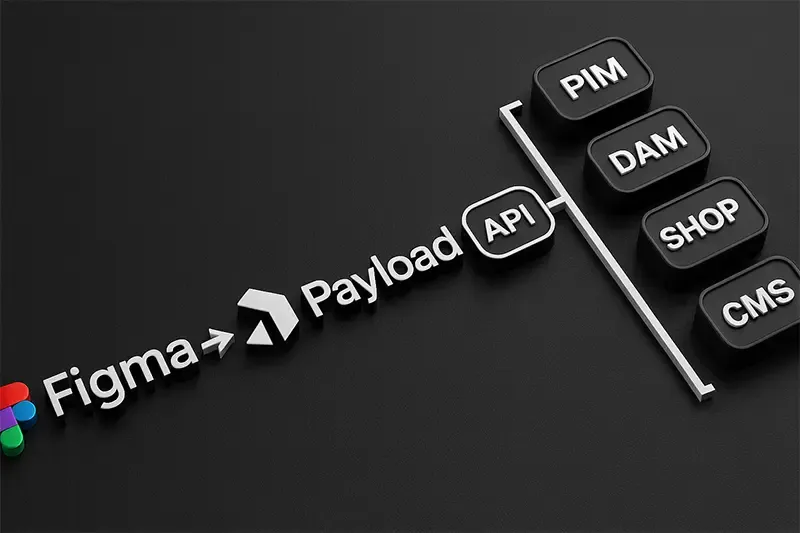
This acquisition creates a platform that seamlessly combines design and content. Payload will become the central link between Atomic UX/UI components on the one hand and relevant, rich, real-time data, assets and content on the other.
Via our Unified Content API, Payload gains access to all data, assets, content and functions from:
• PIM (Product Information Management)
• DAM (Digital Asset Management)
• CMS (Content Management System)
• SHOP (E-Commerce)
This makes Payload a key component for the composition and fusion of content and design.
The vision: design-to-deployment without media discontinuity
Imagine this: designers create modular UX/UI components in Figma. With a single click, these are played out directly in Payload – as sections that are immediately enriched with real-time data from PIM, DAM and CMS. No manual transfers, no copy-paste orgies, no breaks between design and development.
That would be a real game changer for:
• Design-Driven Development
• Composable Digital Experience Platforms
• Atomic & Headless Architectures
What's still missing?
Now all that's missing is the button in Figma that displays all UX/UI components and creates them directly in Payload as sections. Surely that's on the roadmap for next year, right?
Fazit
Figma's acquisition of Payload is more than a strategic move – it marks the beginning of a new era for digital product development. Those who rely on MACH principles, composable architecture, and unified content APIs today will be ahead of the curve tomorrow.