Nowadays, when you receive a product, you will usually find extensive documentation in printed format.
Many companies also make this documentation available for download. However, it is increasingly being adapted for mobile devices – a first step towards a future in which printed documentation will only be required to a minimal extent.
A paper-based operating or assembly manual included with the delivery is still common practice for most products that require a certain amount of explanation. In addition, it has become standard practice for most manufacturers to also provide a digital version of these documents, for example a PDF, on their website.
As the intensive use of mobile devices such as smartphones and tablets is now widespread, optimised versions of the relevant documents are also available for display on these devices. The solutions that manufacturers rely on here range from display- and size-optimised PDFs to newly designed content formats with navigation options adapted to mobile devices, to complex apps that exploit all the possibilities currently offered by mobile devices.
The application scenarios for such mobile documentation are diverse. The automotive industry in particular is playing a pioneering role here. Audi, for example, is relying on augmented reality technology with its eKurzinfo app. This provides users with brief information on how to operate the object at which they point their smartphone camera.
Documentation in the future
As rapid technological developments are currently taking place in the field of mobile devices, those responsible on the manufacturer side must place greater emphasis on future scenarios regarding the provision of product information, including technical communication.
One development that is emerging for tomorrow is instructional videos. In the future, these will largely supplement text-based instructions. FAQ apps are another conceivable application – they give users access to the information they need in a way that is specific to the application, situation and target group. It is also to be expected that these types of apps will be voice- and gesture-controlled in the near future.
It is also likely that new forms of information provision will make interaction with users more relevant. Feedback functions are one example of this. The bidirectionality created in this way is of great value in customer communication and the resulting customer loyalty.
The uncomplicated integration of these mobile solutions with other media – such as print or even the product itself – plays a central role in all these scenarios. They are therefore an ideal field of application for the use of media-connecting bridge technologies such as QR codes.
No more print thanks to mobile?
For some product information, such as internal company documentation or sales materials, apps are already replacing printed documents on a large scale, ensuring that these can be printed in significantly smaller quantities.
In the area of user manuals, print versions will certainly continue to exist for a long time to come – but fewer of them, and increasingly only on request. Therefore, the mobile provision of manuals can already offer enormous savings potential in traditional technical editing today.
Legal situation
There have been notable developments, particularly with regard to the question of whether and to what extent paper can be dispensed with. Security concerns, such as those arising from the interpretation of the Machinery Directive or the Product Safety Act, must certainly be taken seriously. Many lawyers emphasise that case law is based on the paper form. However, the primary question is what information objective needs to be achieved. Two criteria are particularly important here: firstly, the availability of the information at the time it is needed by the user, and secondly, the manufacturer's ability to prove this availability.
A paper manual can indisputably be supplied with the product because it is physically present. In practice, however, due to a lack of archiving, the availability of printed manuals is often lower than that of electronic versions, which can be downloaded from the manufacturer's website after a quick search – usually even for older series.
It is therefore necessary to question media concepts, find the right media mix for optimal availability of information, and use this to develop a legally sound justification for reducing or even eliminating print solutions.
Help with this is provided by an EU regulation – in this case, Regulation 207/2012 from 2013. For medical devices that are generally used by specialist personnel, it allows instructions for use to be provided in electronic form only. Printed instructions are now only to be provided on request. There are still a few conditions attached to this option – in particular, that the risks of an electronic solution are no greater than those of a printed manual. Nevertheless, this opens the door to a development that could also spread to other industries. The conditions of the regulation also outline a procedure for providing a media mix with a sound justification in terms of product safety law.
So what should be done?
The starting point is a thorough target group analysis that includes the possibilities of using different media. This analysis must consider the information requirements in detail. Then, differentiated and feasible media concepts can replace inadmissible blanket statements for or against the paper solution. Once a suitably justified media concept is available, the risk assessment for the choice of media must be expanded and the media concept adapted if necessary.
Joint services provided by INFOLOX and partners
- Development or review of the rough concept for the information landscape and its foundations against a legal and normative background; expert opinion on feasibility and fundamental risks
- This may require or be advisable to conduct requirements research, compile a requirements catalogue and review existing information products
- Once the draft media concept is available: risk assessment and recommendations for adapting the media concept
- Complete development and implementation of the concept for the information landscape in collaboration with Schmeling + Consultants by INFOLOX together with the customer
Customer example implemented by INFOLOX
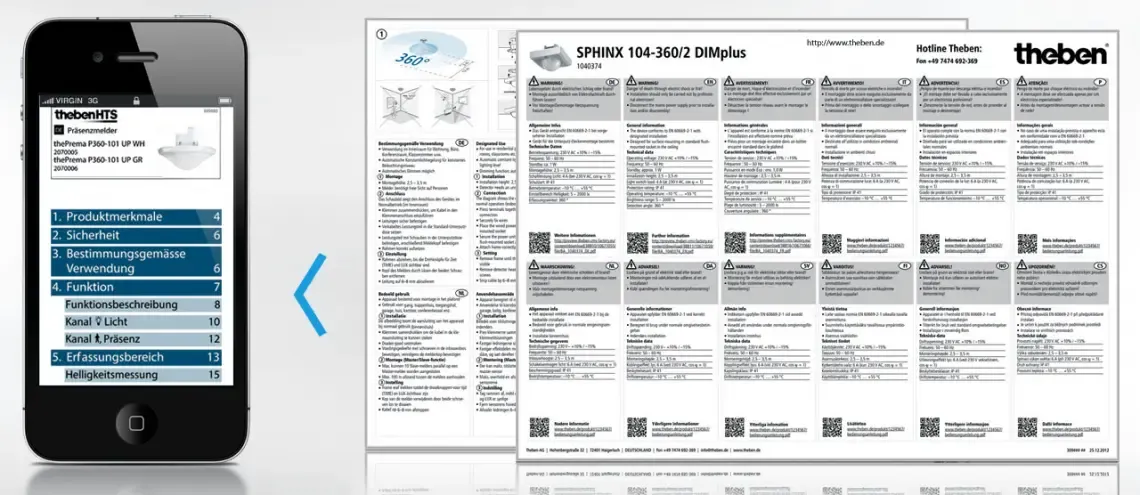
Theben AG, which collaborated with INFOLOX on a pioneering project, demonstrates that it is possible to reduce the enclosed operating instructions to an absolute minimum. Short operating instructions containing the most important hazard warnings and technical data were designed for each product. A QR code and URL were also placed on the document. When scanned with the appropriate device (iPhone, Android phones, etc.) and software, the QR code redirects directly to the long version of the operating instructions – a PDF file optimised for mobile devices.
In future, Theben will only include short instructions with all its products. It goes without saying that this will massively reduce the printing and shipping costs for product documentation.
Theben is also breaking new ground in data management: the short operating instructions are generated fully automatically from the PIM system. All other product data is also maintained there, for example the technical data that forms part of the short instructions.
Media neutrality and process landscape
Future forms of publication for technical documentation have a common basis: mobile documentation is becoming part of multichannel publishing and must therefore be stored and maintained in a media-neutral format in a PIM or editorial system.
The processes used to automatically create content for mobile devices are no different from those used for other product communication publications. Technical writing content is also part of the information process for a product and should therefore be integrated into the processes and structures of a product information environment. This also allows synergies to be exploited to the full.