Until now, architects have worked with drawings and plans that are submitted to the client, specialist engineers, fire safety experts and authorities. When changes are made, not only the planning documents but also calculations and quantity surveys as well as other planning and approval aspects have to be adjusted. All parties involved receive updated planning documents and compare these with their specialist plans. This requires a considerable amount of coordination and work.
With BIM, on the other hand, planning is carried out in a digital 3D model. Changes are immediately available to everyone. The comprehensive information contained in the BIM model leads to higher quality and efficiency in all planning and construction phases, from maintenance and operation to demolition. They enable model-based time and process planning ("4D") as well as automatic cost planning ("5D"). Analyses of energy, lighting and water management, model-driven construction, export of order lists and production plans: the possibilities (and thus the number of "D"s) are virtually limitless.
Due to its numerous advantages, BIM is increasingly becoming mandatory: public authorities, large companies and creative architects around the world are relying on BIM.
To use BIM, component manufacturers must provide their products in various native data formats for CAD systems as so-called BIM objects. BIM objects are geometric representations of products, including defined attributes and parameters (e.g. dimensions, usage and installation context, materials, etc.). In addition, BIM objects require stored logic and rules to ensure that the real complexity of the product is reflected. These requirements must be implemented taking into account the minimum storage capacity of the objects, as otherwise the CAD systems will reach their performance limits.
Another challenge is to merge these rich BIM objects with the rest of the product data and make them available to planners, developers and other interested parties in the respective languages and at the required level of detail.
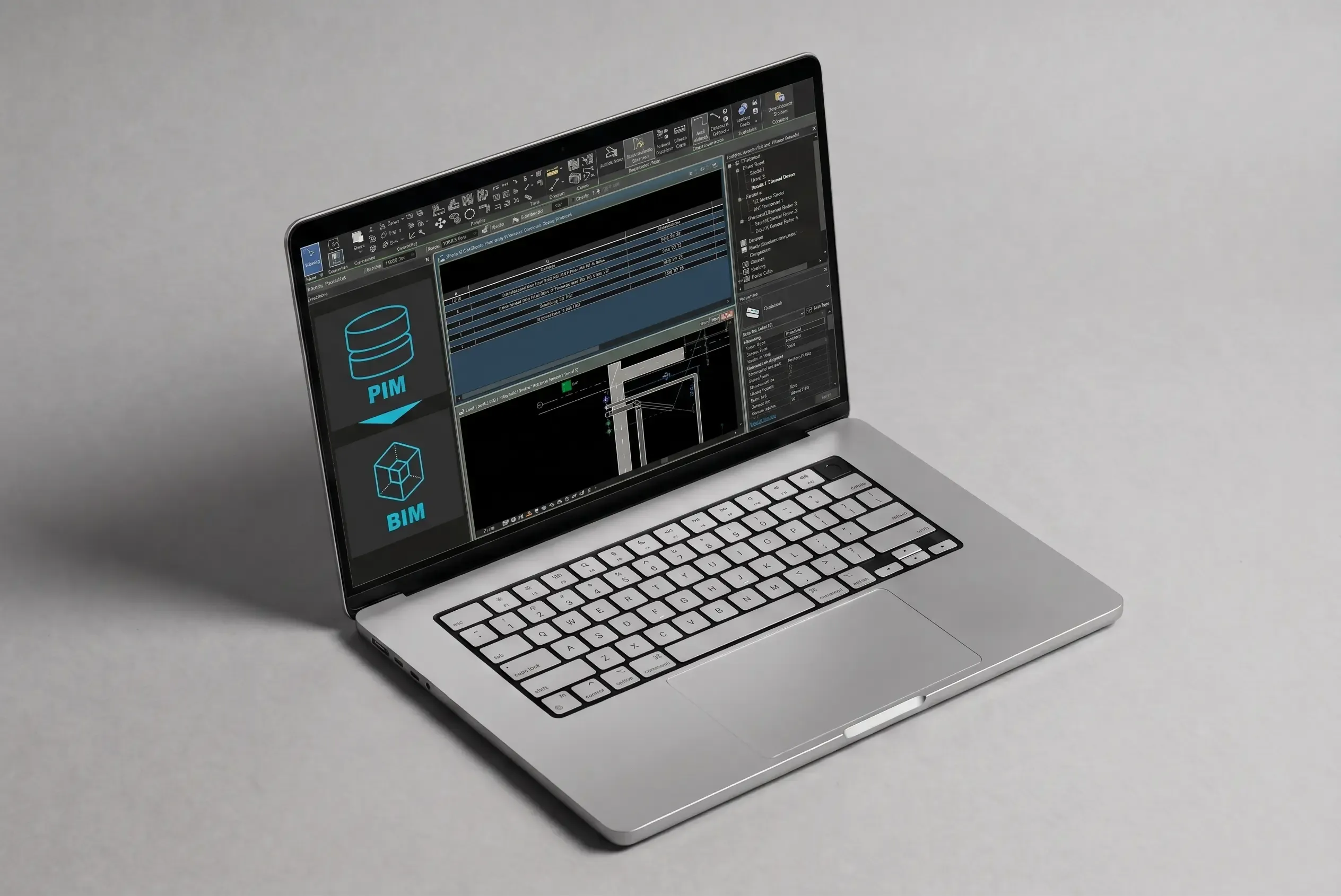
Ideally, BIM systems are linked to PIM systems at this point – short for Product Information Management systems.
A PIM system is basically nothing more than a database. This database can be understood as a "data hub". It supports the central management of product-related information and its distribution across various channels and connects to the creation of your BIM content: This allows you to create your BIM content more efficiently and with high quality and timeliness.
Structured data preparation in the PIM system is carried out under the single sourcing aspect. It enables access to up-to-date information – on various channels and in different languages. This reduces the risk of errors in the product data.
Tasks and benefits of PIM systems
The PIM system supports the process of product-related information exchange. Its processes can be controlled centrally and in a standardised manner by the PIM system. The various functions of the PIM system ensure the quality of product information.
The depth of data is adjusted within the PIM system. This data then serves as the main data source. It is then accessible throughout the entire building life cycle.
Since up-to-date and consistent data is a top priority these days, a PIM system offers the ideal basis.
The above facts clearly demonstrate the need for a database-based approach when dealing with BIM objects. The aim is to integrate existing systems intelligently so as not to create further data silos among component manufacturers.
Gregor Müller, Managing Director of BIMsystems GmbH, our partner for BIM, also comments on this:
"The intelligent networking of PIM and BIM is essential for the sustainable and efficient handling of BIM. The PIM system is the place where product information and media from a wide variety of sources are brought together, maintained and expanded. For the efficient and sustainable handling of BIM, it is important to network this information from the PIM system with database-based BIM systems."
This results in different scenarios for component manufacturers when it comes to managing BIM data. If a powerful PIM system is already in use, BIM data can be entered into it. Otherwise, the introduction or renewal of the PIM system should also be evaluated when introducing BIM.
It is far better to link the PIM system to the component management system. This ensures that the latest BIM data is always available or linked in the PIM system. When supplying data to online catalogues, shops, apps and other publication channels, data from a wide variety of sources is automatically merged.
See how our customers ACO Haustechnik and Kampmann use BIM based on PIM systems!
INFOLOX's strength in creating automated best-of-breed solution landscapes for marketing, product data management and e-commerce also comes into its own when it comes to BIM management. With the Stuttgart-based BIM consulting and software company BIMsystems GmbH, INFOLOX has also gained a highly competent partner for the complex topic of BIM. We would be happy to advise you on all questions relating to BIM and PIM.
If you are interested, please contact Alexander Pircher, Managing Director of INFOLOX GmbH, at alexander.pircher@infolox.de or on +49 8282 275894-3 and take advantage of the opportunity for a no-obligation consultation!
About our partner BIMsystems
BIMsystems was founded in 2015 by Gregor Müller, a team of developers and experts from the construction industry. The software company specialises in data management within the framework of the model-based planning method Building Information Modelling (BIM) and is the world's only provider of a cloud-based BIM system – based on corma technology.
In the construction industry, BIM is considered a key technology for digitalisation. The BIM system from BIMsystems aims to provide all parties involved in the construction process with the technical BIM infrastructure that enables networked data exchange along the value chain of a property.
Given the growing volume of data and the need for integration, simply providing BIM content in portals is no longer sufficient. The waya plugin from technology leader BIMsystems helps to increase efficiency – thanks to corma.
Customers such as Hörmann, Saint-Gobain and BayWa, as well as numerous companies currently implementing the solution, trust in the efficiency and sustainability of the BIMsystems solution.