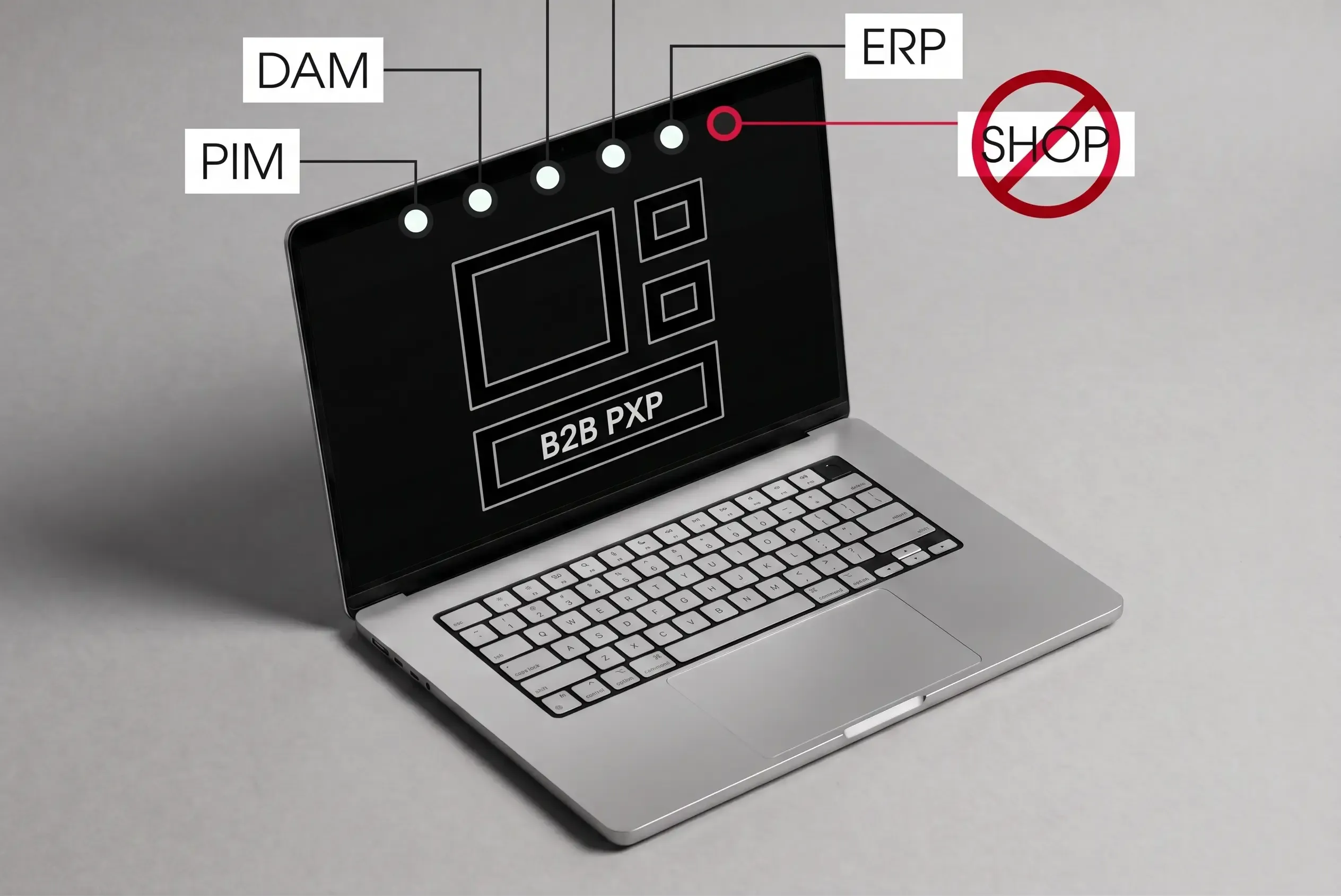
Dear network, I would like to take this opportunity to discuss a theory with you. There are certainly valid arguments that claim that in the future, in the B2B PXP environment (B2B product experience platforms with MACH architecture or composable content & commerce) with PIM, DAM, CMS including ERP and CRM integration, there will no longer be a need for dedicated shop systems and therefore PIM/DAM systems such as Viamedici, Contentserv, Picturepark | a FotoWare company and content management systems (CMS) such as Storyblok, Ibexa, Drupal & Co. come to the fore.
Why?
In a B2B MACH architecture with many specialised systems, the online shop is increasingly taking a back seat, as the leading systems in B2B commerce are ERP and CRM, such as SAP , Microsoft Dynamics 365, etc.
All transaction-related data, such as availability and prices – which often vary due to customer-specific agreements and contracts – come directly and usually in real time from the ERP system. Customer information, including roles, rights, etc., comes from the CRM system.
All transactions (orders, returns, complaints, changed billing and delivery addresses, etc.) are also transferred back to the ERP and CRM systems. As a result, ERP and CRM systems are evolving to provide many services directly via interfaces, such as shopping cart/order, checkout, price calculation, order history, order status, and address changes.
This eliminates the need for an additional, comprehensive shop system in many B2B scenarios. Instead, "only" a customer-side front end needs to be provided for these functions, integrated into the PIM/DAM-fed online catalogue and, if necessary, supplemented with corporate content in the CMS. This is where the possibilities and strengths of the interface- and service-based MACH approach come into play.